
03 Gut Check AI
Gut questions?
Start with
your logs.
Gut Check AI is a conversation with your gut diary. Bring a focused question about the meals, stool and symptoms you have recorded, then check the answer against the entries behind it.
For iPhone · Part of the Get Regular app

Gut Check AI
“What was different on the days
I recorded bloating?”
Ask. Review.
Go back to the record.
In the rhythm of your day
Your day goes in.
Your questions get
more specific.
- 01
Bring your record.
Your logs give the conversation context. Missing entries and uncertain details still matter.
Meals · stool · symptoms - 02
Ask a focused question.
Start with an observation you can check, rather than asking AI to explain your whole health.
A question from your own day - 03
Check what comes back.
Compare dates, ingredients and symptoms with the original entries. A personalized answer can still be wrong.
Review · question · correct
Gut Check is an AI feature, not a doctor. It cannot confirm a food intolerance, diagnose IBS or decide whether you need medical care.
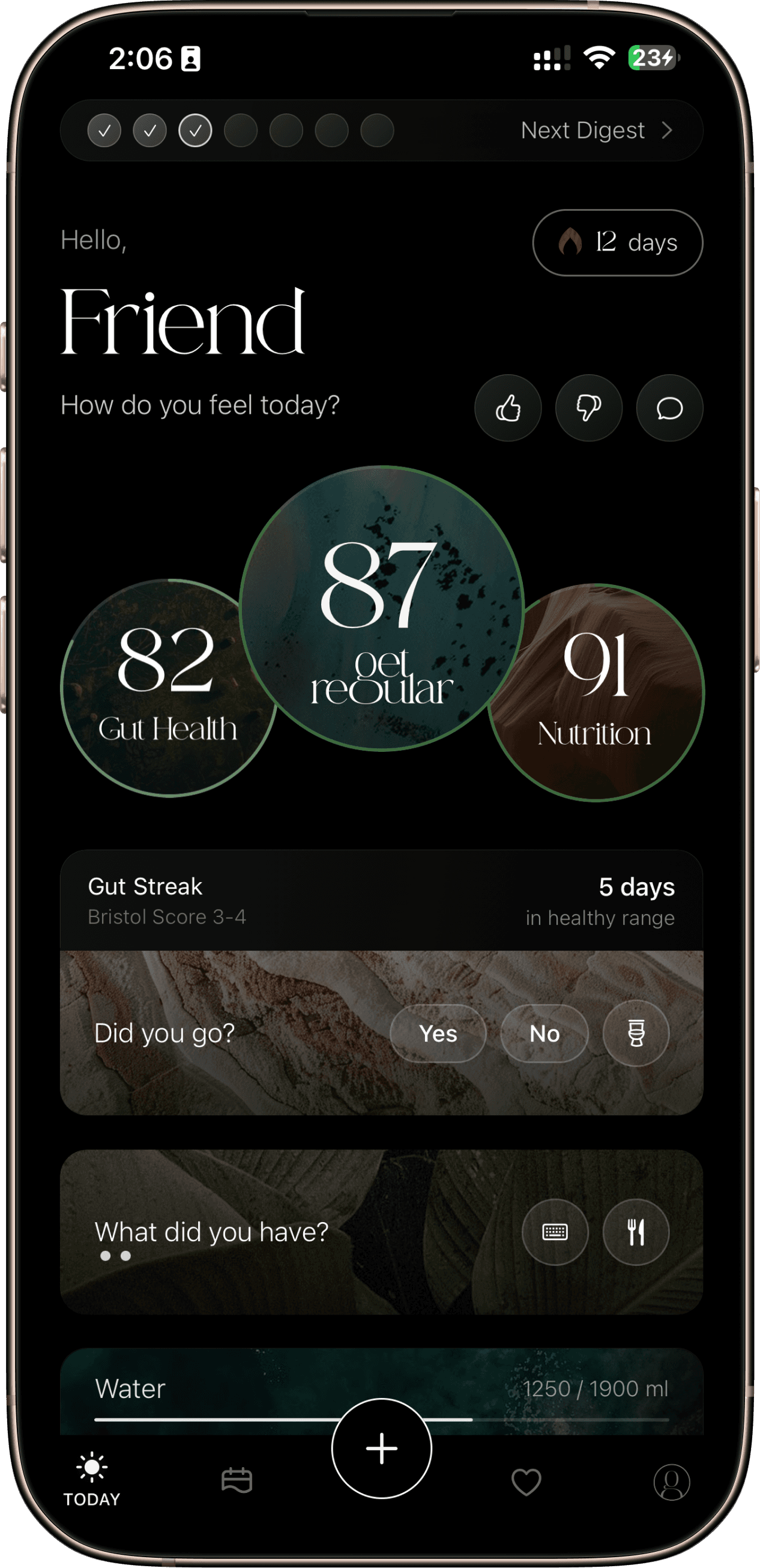 Existing Get Regular product imagery
One app. The whole day.
Give each
observation
some company.
Meals, stool and symptoms live in the same ongoing record. Use your scores, history and AI-assisted insights as ways to look back, rather than a verdict about your health.
See the complete app tourMeet the science behind the storyA closer look
The details,
when you want them.
A record is a starting point. Gut Check is Get Regular's AI-assisted conversation feature, described in the App Store listing as a way to ask questions about your logged patterns.
Start with an observation you can check
A focused question is easier to assess than a broad request to fix your gut. Ask about something you recorded, then compare the answer with the underlying entries. You are looking for a clearer description or a question to explore, rather than a confident story that goes beyond the record.
An AI response can sound certain even when the information is incomplete. If the answer refers to a meal, symptom or timeline you do not recognize, check it. The fact that an explanation is personalized does not make it medically correct.
- What observations in my diary are relevant to this question?
- Which details are missing from this summary?
- How could I describe this pattern clearly at an appointment?
Ask for a clearer record, then check the answer
These are example questions you could ask, not a demonstration of responses tested in the current app. They keep the focus on information you can verify instead of asking AI to decide what is wrong.
| Try asking | Check the response for |
|---|---|
| Which entries are you using to describe my bloated days? | Recognizable entries and dates, including any gaps. |
| What was different on days without recorded symptoms? | A distinction between no symptoms and no symptom entry. |
| Which parts of that explanation are uncertain? | Missing information and alternative explanations, rather than a definitive trigger. |
| Help me organize questions for my appointment. | Questions that match your concerns, without a diagnosis or treatment plan. |
Keep a boundary between a suggestion and a decision
Gut Check is an AI feature, not a clinician examining you. It cannot confirm an allergy, diagnose IBS, establish the cause of symptoms or rule out illness. It should not decide whether you need medical attention or override advice from a qualified professional.
If a response proposes a dietary change or supplement, treat it as a topic to discuss with a professional who knows your history. NIDDK describes individual variation in IBS dietary approaches and a possible role for a dietitian. A conversational answer cannot supply that professional assessment.
Know what you are choosing to share
The published privacy policy describes sending chat content and selected health inputs to OpenAI for processing. It also describes retaining conversations and persistent health facts for personalization. Read that policy before entering details you consider sensitive.
You do not need to include someone else's personal information to ask a question about your own record. Keep the question relevant, and remember that a chat is not a confidential consultation with a healthcare professional.
Gut Check sits alongside the diary. The useful outcome is an observation you can verify, an uncertainty you can name or a better prepared question. It is not a promise that AI will find a trigger, improve symptoms or provide the right treatment.
A confident answer can still need correcting
If an answer describes an ingredient, symptom or date incorrectly, return to the original entry before acting on it. The release history describes ingredient editing and entry deletion; check the current controls in your app. This is not confirmation that every generated response or suggested stool type can be edited in the same way.
For a product error, contact hello@getregular.com with the feature, app version and a brief description of the problem. You do not need to attach stool photos or a full health history to explain a software issue. A health concern belongs with an appropriate healthcare professional, even if the app is also behaving unexpectedly.
Before you start
Good questions.
Is Gut Check a doctor?
No. Gut Check is an AI-assisted feature for exploring recorded information. Its responses may be incomplete or wrong and do not replace individualized medical care.
Does it remember things from previous conversations?
The published privacy policy describes stored conversations and persistent health facts used for personalization. The controls for viewing, correcting or removing those facts need product verification; read the policy and ask the company before sharing details you are unsure about.
Can it prove that a food is my trigger?
No. A personalized response is still an interpretation of incomplete information. Compare it with the record and treat any proposed association as a question, not proof of a cause.
Try a starting point
How the AI works
See the difference between your inputs, an interpretation and a verified fact.
Product information & sources
Feature descriptions follow the public listing and version history checked on 20 October 2026. Controls and access can vary by version and offer. Illustrations are labeled; they are not real user records or clinical results.